

Most Pixel users upgrade assuming their old case will follow them. The Google Pixel 10 Pro XL encourages that assumption because it shares the same footprint as the Pixel 9 Pro XL.
When you slide the new phone into the previous case, everything looks right. The corners wrap, the sides grip, and the outline matches. That first impression is what misleads people.
Case compatibility is never about the silhouette. It’s about how material tracks the real geometry of the device, and that geometry changed.
Pixel 9 Pro XL vs Pixel 10 Pro XL Compatibility
| Aspect | Pixel 9 Pro XL | Pixel 10 Pro XL | Impact |
|---|---|---|---|
| Dimensions (mm) | 162.8 × 76.6 × 8.5 | 162.8 × 76.6 × 8.5 | Creates a false sense of fit |
| Camera Bar | Smaller, flatter ridge | Wider, taller, higher slope | Old cutouts shift or press against the bar |
| Button Profile | Shallow buttons | Similar button height, small alignment differences | Older cases may not press accurately |
| Corners | Softer curvature | Minor tolerance differences | Older cases may lose top-edge seal |
| Weight | 221 g | 232 g | Slight shift changes tension behavior |
| Magnetic System | None | Pixelsnap Qi2 alignment | Older cases disrupt charging alignment |
Where the Fit Fails
A Pixel 9 Pro XL case was shaped around specific landmarks: the flatter camera bar, the shallow button height, and the softer corner radius. Each of these shifts slightly on the Pixel 10 Pro XL. The new camera bar rises higher, so the case presses against the ridge instead of framing it.
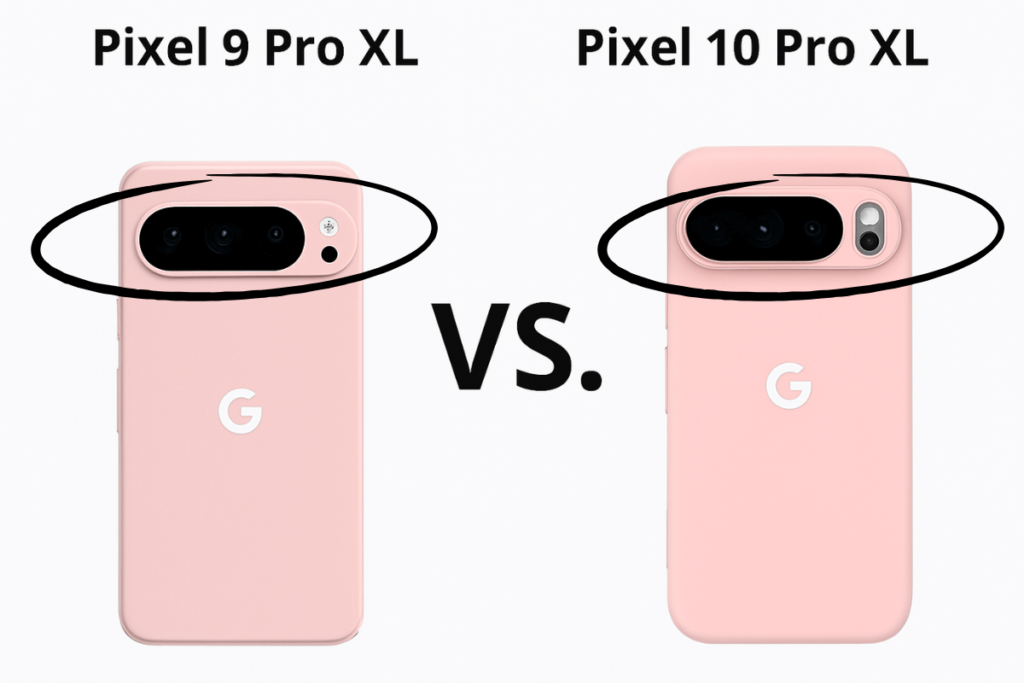
TPU adapts at first, but the pressure stacks around the flash and lens area and the sidewalls loosen. Hard shells resist the new slope entirely, and that resistance forces the corners to lift.
Even small changes in button placement or tolerance can cause older case caps to misalign and lose press accuracy. The press becomes soft or inconsistent because the cap no longer meets the true actuation point.
Any slight shift in corner shaping or frame tolerance also causes earlier cases to lose their seal at the top edge. Once the material relaxes, the upper edge begins to pull away by fractions, weakening impact protection.
The bottom design introduces one more limit. The Pixel 10 Pro XL needs clear space for its Qi2 magnetic alignment and adjusted speaker path. Older cases sit across those areas or weaken the magnetic lock because they were not molded for them.
How to Test a Case That Might Not Fit
If you want to confirm whether an old case is safe to use even temporarily, these checks reveal the truth quickly:
Corner seal test
Press each corner while the phone sits on a flat surface. Any movement or lift means the case cannot absorb shock correctly.
Camera clearance test
Take a photo with flash. Glare or shadow indicates the cutout is interfering with the bar.
Button accuracy test
Press each button directly in the center. If the click shifts, skips, or requires edge pressure, alignment is off.
Back and face stability
Place the phone face-down and back-down. Rocking or uneven contact shows the case is not following the updated surfaces.
Wireless test
Place the phone on a Qi or Qi2 charger. If the connection is weak or inconsistent, the case is blocking the coil or magnet path.
A case that fails any of these checks should only be used briefly. For real protection, you need a case molded for the Pixel 10 Pro XL’s updated geometry.
Final Take
The Pixel 10 Pro XL may share the same dimensions as the Pixel 9 Pro XL, but everything that dictates case fit changed: the camera ridge, the revised case tolerances, and the Qi2 alignment system. A Pixel 9 Pro XL case may hold the new phone for a moment, but it cannot protect it the way it should.
The correct case is not an upgrade. It is a requirement.
More Pixel Compatibility Guides