

Cracked front glass, a damaged internal display, and failed touch input are different problems. A phone can have visible cracks with a normal image and accurate touch, or it can develop black areas, colored lines or touch failure with little visible damage to the outer glass.
“Broken LCD” (Liquid Crystal Display) is often used as a general name for internal screen damage, but modern smartphones may contain either an LCD or OLED (Organic Light-Emitting Diode) panel. Identifying which function has failed helps explain the symptoms and the type of repair being offered.
How a Phone Screen Is Built
A conventional smartphone screen has three relevant functional parts:
- Cover glass: The outer layer you see and touch. It protects the components beneath it.
- Touch-sensing layer: The component that detects taps and swipes. It is also commonly called the digitizer.
- Display panel: The LCD or OLED component that produces the visible image. LCD panels control light from a backlight, whereas OLED pixels produce their own light.
How to Tell What Part of the Screen Is Damaged
Check the displayed image and touch response separately rather than judging the phone from the visible crack alone.
| What you observe | What it can indicate |
| Visible crack with a normal image and accurate touch | Cracked cover glass or screen protector |
| Visible crack with unresponsive touch areas | Cracked cover glass or protector, with a possible touch-input problem |
| Black or ink-like patches beneath the glass | Internal display-panel damage |
| Vertical or horizontal lines after an impact | Display-panel or display-connection damage |
| Missing image areas or abnormal colors | Internal display-system damage |
| Flickering that began after physical damage | Possible panel or display-connection damage |
| Normal image with an area that does not respond after impact | Possible damage to the touch-sensing component |
| Incorrect or unintended touch input | Accessory interference or a touchscreen fault, but not proof of physical damage |
| Black screen while the phone still rings, vibrates or produces sounds | Possible display-system failure, but not proof that the panel itself is broken |
An impact can compress or flex the screen stack without breaking the outer glass. That movement can damage the panel or its electrical connections beneath an apparently intact front layer.
If the image is normal and the touch problem did not begin after an impact, remove the case and test the screen again. If touch response does not improve and the protector is intact, remove it according to its manufacturer’s instructions and repeat the test. An adhesive protector may not be reusable after removal, and a shattered protector should not be removed solely for this test.
Is the Phone Screen Broken or Just the Screen Protector?
Inspect the phone under angled light and locate the outer perimeter of the installed protector. Tempered-glass protectors commonly leave a visible boundary around the display, speaker opening or front camera area.
Trace the crack toward that boundary. A fracture that stops at the protector’s edge or a chipped area that clearly sits above the original glass indicates that the protector may have taken the damage. If the line continues beneath the boundary, the phone’s cover glass may also be cracked.
Edge-to-edge protectors can hide their perimeter, making visual confirmation more difficult. Do not run a fingertip across broken glass or peel away a badly fragmented protector. Ask a repairer to remove it if the damaged layer cannot be identified safely.
Does Cracked Glass Mean the Whole Screen Must Be Replaced?
The visible damage may be limited to the cover glass, but repair methods depend on how the screen is manufactured. Cover glass, touch components and display panels are commonly laminated together with optically clear adhesive. Many repair services therefore replace the complete screen assembly instead of separating one damaged layer.
Current replacement parts such as an iPhone 16 screen and digitizer are supplied as a combined assembly. A quotation for full screen replacement does not necessarily mean that the LCD or OLED panel has failed. It may be the standard repair method for that model.
Specialist refurbishment services can replace only the outer glass on some screens while retaining a working original panel. The process requires equipment to separate the bonded layers, remove the old adhesive and laminate new glass without damaging the display. Availability depends on the phone model and the repair provider.
Can You Fix a Cracked Screen or Broken Display?
A cracked screen or damaged display can be repaired, but no liquid, adhesive or phone setting can restore cracked cover glass or damaged display pixels. Pressing harder on an unresponsive area is not a fix and places additional force on the damaged screen.
DIY screen replacement is possible on some phones when the correct part and model-specific procedure are available. For most owners without smartphone-repair experience, a qualified repairer is the more practical choice. Display removal can involve controlled heating, adhesive cutting, fragile internal connectors, new display adhesive and configuration after installation. Apple’s self-service repair manuals treat display replacement as a structured procedure with dedicated tools, instructions and diagnostics.
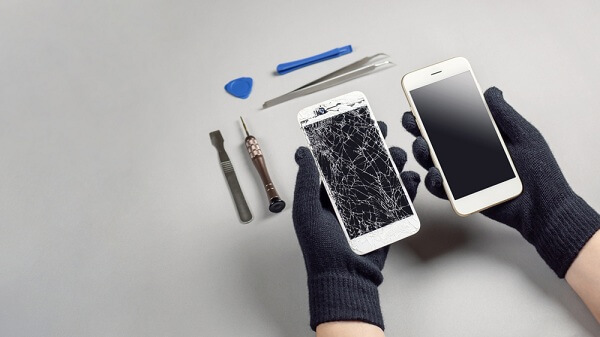
Cracked phone glass should not be treated as purely cosmetic. Loose or raised fragments can make the screen unsafe to handle, and physical damage may reduce the phone’s original dust and water resistance. Avoid further water exposure until the phone has been inspected. Google notes that device damage can diminish or eliminate rated dust and water resistance.
We advise backing up accessible photos, messages and other important data before repair because the phone may be reset or returned erased during service. Before approving the work, ask whether the repair involves glass-only refurbishment or a complete display assembly and whether the replacement matches the phone’s original LCD or OLED technology and refresh rate.
Also confirm whether brightness or model-specific display functions may change, whether post-repair configuration is required, and what warranty applies to the replacement part and labor. Ask for the full repair quote and, especially for an older model, compare it with the phone’s current value and the cost of replacement before proceeding.
Can a Screen Protector or Phone Case Prevent Screen Damage?
A screen protector provides a sacrificial layer that can take scratches and some direct impacts before they reach the phone’s cover glass. It cannot make the LCD or OLED panel impact-proof.
A shockproof phone case with a raised front edge creates separation between the display and a flat object when the phone is set down. During a drop, that raised rim can keep the screen edge from becoming the first contact point, but protection still depends on the impact angle, force and case fit.
The 9H label found on many tempered-glass protectors normally refers to pencil hardness, which measures scratch resistance under a particular test method. It is not a drop-protection rating or a guarantee that the protector will not crack.
Choose a protector made for the exact phone model and pair it with a case whose rim does not overlap the protector’s edge. Pressure at that boundary can lift the protector, create air bubbles near the edge, and allow dust to collect underneath.
Dede
Broken LCD My TV
Chris
How i can help you Dede?