

No. A Samsung Galaxy S24 case will not fit the Samsung Galaxy S26.
At a glance the two phones appear similar. Both belong to Samsung’s compact flagship line and follow the same flat-frame design language with three rear cameras arranged vertically. Because the devices look close in size and layout, it is easy to assume that a case built for one model should transfer to the other.
Case compatibility depends on precise physical alignment between the phone chassis and the molded cavity inside the case. Even small changes to camera structure or body dimensions shift those alignment points, so the case may no longer seat correctly.
Camera Geometry Changes
The most immediate compatibility problem comes from the rear camera structure.
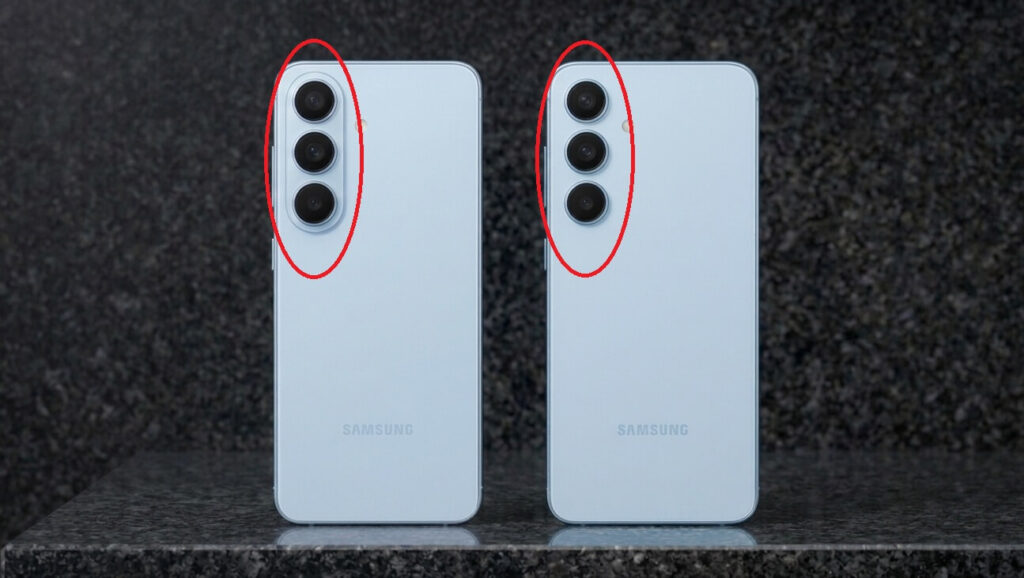
The Galaxy S24 uses three separate camera rings mounted directly to the back panel. Cases designed for the S24 mirror that layout with three circular openings positioned precisely around each raised lens.
The Galaxy S26 introduces a different camera architecture. Instead of three isolated rings with gaps between them, the lenses are integrated into a unified camera housing across the upper portion of the back panel.
That structural change requires an entirely different case opening. A case molded for three circular cutouts cannot properly clear a single elongated camera housing. The raised edges interfere with the circular openings, preventing the case from sitting flush along the top edge of the phone.
Because the camera structure sits at the highest point of the phone’s rear surface, this interference alone is enough to stop proper installation.
Dimensional Shifts: Height, Width, and Thickness
Beyond the camera housing, the physical dimensions of the phone also changed.
| Model | Height (mm) | Width (mm) | Thickness (mm) |
|---|---|---|---|
| Galaxy S24 | 147.0 | 70.6 | 7.6 |
| Galaxy S26 | 149.6 | 71.7 | 7.2 |
| Difference | +2.6 | +1.1 | -0.4 |
The Galaxy S26 is both taller and wider while becoming slightly thinner.
Phone cases are molded around exact reference points on the device body. These reference points include the USB-C port, side buttons, display edge, and frame corners. When the phone dimensions change, those reference points shift relative to the cavity inside the case.
Even a difference of one or two millimeters moves ports, buttons, and edges away from the positions the case mold was built around.
Case Molding Tolerances
Phone cases are produced using molds engineered with extremely tight tolerances. The internal cavity is designed to grip the device along specific pressure zones on the frame and corners so the case locks securely into place.
When the phone becomes taller or wider, those pressure zones shift along the frame. The corners may no longer align with the molded contact points that allow the case to clip securely around the device.
Instead of snapping into place, the case may flex, twist, or refuse to seat completely along one edge.
Button and Port Alignment
Case molds also include openings for hardware controls and charging ports. These openings are positioned so the molded button covers sit directly over the phone’s internal switches. When the device dimensions change, those switches move slightly relative to the case cavity.
Even a small shift can cause the molded button caps to press slightly above or below the center of the switch, which changes how the buttons feel when pressed. Charging ports can also drift slightly off-center, forcing cables to enter the opening at a slight angle.
Because cases rely on precise alignment for both comfort and functionality, these shifts prevent a proper fit.
How to Choose the Right Galaxy S26 Case
Selecting a case for the Galaxy S26 begins with choosing one molded specifically for the phone’s chassis and camera housing. Cases engineered for this model follow the device’s exact dimensions and camera geometry so the camera cutout clears the entire housing correctly and the frame sits evenly along the edges of the phone.
The camera area deserves the closest attention. A properly designed case includes a raised camera surround that sits slightly above the lens surface. Some designs also include tempered glass lens protectors or metal camera rings that fit around each lens opening to provide additional protection without affecting image quality.
Magnetic compatibility has also become an important feature. Many Galaxy S26 cases now include an integrated magnetic alignment ring embedded within the back panel. When correctly positioned inside the case structure, the ring allows secure attachment to magnetic chargers, mounts, and accessories while still supporting standard wireless charging.
Material construction determines how the case balances protection and thickness. Slim TPU shells provide flexible impact absorption and secure grip for everyday use, while hybrid designs combine a rigid polycarbonate back with shock-absorbing edges to improve drop resistance.
Final Answer
A Samsung Galaxy S24 case will not fit the Galaxy S26.
The Galaxy S26 uses a unified camera housing and revised body dimensions that prevent S24 cases from aligning correctly with the frame, buttons, and ports. For proper fit and protection, the Galaxy S26 requires a case designed specifically for its chassis.
Related compatibility guides: